IPB University Summer Course “CoffeeCrack 2026”: Unveiling Indonesia’s Bean-to-Cup Journey Through Science and Technology
IPB University Summer Course “CoffeeCrack 2026”: Unveiling Indonesia’s Bean-to-Cup Journey Through Science and Technology
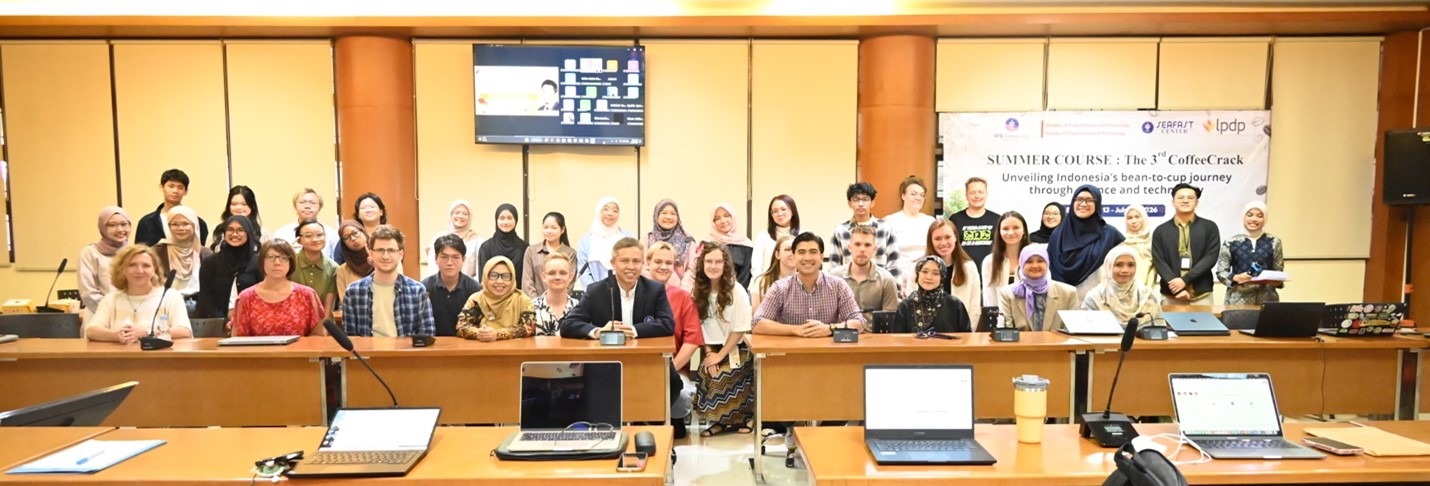
BOGOR, INDONESIA – IPB University successfully hosted the international summer course “CoffeeCrack 2026: Unveiling Indonesia’s Bean-to-Cup Journey Through Science and Technology” from July 13 to 31, 2026. Held in a hybrid format combining self-paced (asynchronous), online, and in-person learning, the program brought together 65 participants, comprising 22 international and 43 national participants.
The in-person sessions were conducted at the Division of Food Science and Technology (DITP), IPB University, and the SEAFAST Center, IPB University, while online participants joined selected activities via Zoom Meetings. Throughout the three-week program, participants explored Indonesia’s coffee journey from bean to cup through perspectives spanning food science and technology, industry, sustainability, health, and coffee culture. Topics included Indonesian coffee varieties, coffee processing from cherry to roasted bean, extraction and brewing, preservation and packaging technologies, fermentation, health benefits and bioactive compounds, as well as coffee waste valorization. Participants were also challenged to develop concepts for prepackaged coffee products based on food science and technology.
The offline activities complemented the academic sessions with direct experiences of Indonesia’s coffee culture and production landscape. Participants visited Vintage Cafe (Rumah Kopi Ranin) to experience coffee culture and explore the connection between coffee, local identity, and consumption. They also joined an excursion to Cibulao Coffee Plantation, gaining firsthand insight into coffee cultivation and the coffee value chain through a “from forest to cup” experience. These activities allowed participants to connect scientific knowledge with the cultural, agricultural, environmental, and socio-economic dimensions of coffee production.
CoffeeCrack 2026 featured an interdisciplinary lineup of academics, researchers, industry practitioners, and international experts. Dr. Dian Herawati (IPB University) introduced the scientific journey from coffee cherry to roasted bean, while Mr. Muhammad Eka Pramudita (Kemenady Coffee and Co-Working Space) discussed advances in coffee technology and brewing. Prof. Dr. Nuri Andarwulan (IPB University) explored Indonesia’s diverse coffee varieties, complemented by insights from Kapal Api Group (led by Dr. Roby Wibisono) on the industrial production of ready-to-drink and instant coffee. Building on the previous sessions on coffee processing, roasting, and brewing, participants continued with a hands-on coffee cupping session using the SCAA method, led by Mr Gemawan Wahyadhiatmika (professional Q-Grader/R-Grader).
The health, processing, and supply chain dimensions of coffee were further discussed by Dr. Puspo Edi Giriwono (IPB University), Prof. Dr. Purwiyatno Hariyadi, and Prof. Dr. Eko Hari Purnomo (IPB University), who addressed coffee health benefits, emerging issues along the coffee supply chain, and thermal and non-thermal preservation technologies, respectively.
The international sessions featured experts from Warsaw University of Life Sciences, Universiti Putra Malaysia, BOKU University, and Technische Universität Berlin. Prof. Dr. Dominika Srednicka-Tober discussed sustainable coffee systems and human health, while Prof. Dr. Renata Kazimierczak explored organic production and its implications for sustainability, food quality, safety, and health. Dr. Belinda Dewi discussed coffee waste valorization, while Dr. Hanan Hasan and Dr. Nur Hanani Binti Zainal Abedin from UPM addressed coffee fermentation and packaging technologies. Dr. Benjamin Henchen of Technische Universität Berlin contributed a socio-economic perspective on economic equity, cooperation, and trans-local food coalitions in global coffee supply chains.
The diversity of CoffeeCrack 2026 was also reflected in its participants, who came from various academic institutions and professional backgrounds, including IPB University, I3L University, Universiti Putra Malaysia, Universitas Bina Nusantara, Hanken School of Economics, Warsaw University of Life Sciences, Universitas Muhammadiyah Surakarta, and professional communities.
By combining academic expertise, industry insights, field experiences, and international interaction, CoffeeCrack 2026 connected Indonesia’s rich coffee culture with contemporary food science and technology. The program encouraged participants to view coffee not only as a beverage, but as a product shaped by science, technology, culture, agriculture, people, and the environment, while strengthening international collaboration and networks in food science and the global coffee industry.